The 80% That Never Gets Written Down
The 80% That Never Gets Written Down
(
2026
)
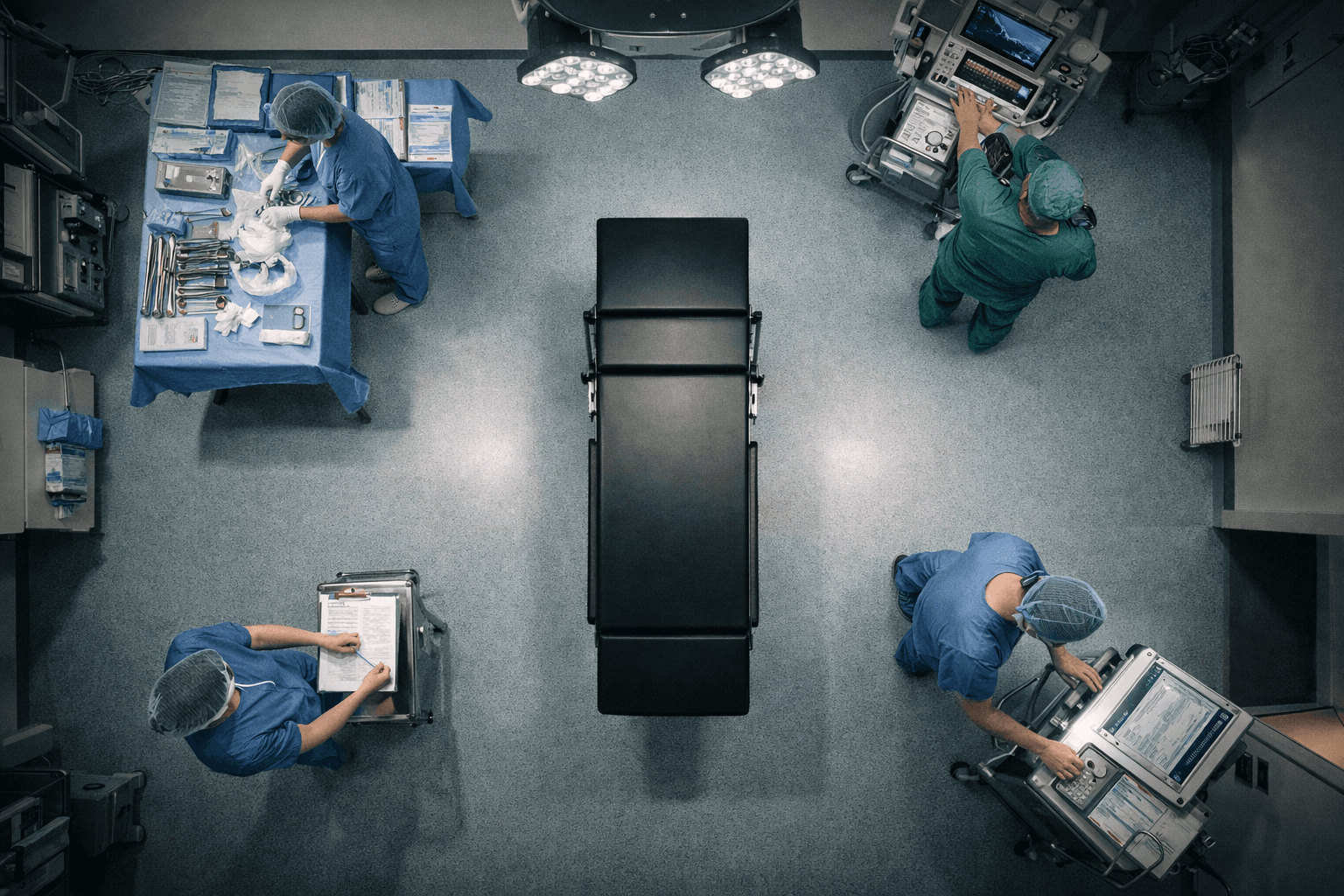
A surgeon walks out of a six-hour case. If you ask them what happened, what they decided, when they pivoted, what made them pause they'll give you an account that feels complete. It probably isn't.
Research on expert decision-making puts conscious recall of intraoperative choices somewhere around 20%. The rest happens beneath the surface and pattern recognition so fast, so automatic, it never registers as a decision at all. The hands move. The case progresses. The choices are made. But there's no moment of deliberate reasoning to attach a memory to.
"The hands move. The case progresses. The choices are made. But there's no moment of deliberate reasoning to attach a memory to."
THE DOCUMENTATION GAP
This creates a problem that has quietly plagued surgical training, safety science, and outcomes research for decades. The op note is a legal document. It captures what was done not how, not why, not the hesitation before a critical maneuver, not the micro-correction that prevented a complication. Retrospective interviews are no better. You can't recall what you didn't consciously register.
Post-case surveys try to bridge this, but they ask surgeons to reconstruct something they never consciously built in the first place. The knowledge exists. It was exercised, just minutes ago. But it's already gone.
WHAT CAN ACTUALLY BE CAPTURED
There are only a few ways to get at surgical cognition in real time. You need to be in the room. You need the right sensors. And you need to be capturing while the case is live not in the hour after, not in the debrief, not in the training session the following week.
This is harder than it sounds. The OR is not instrumented for learning. It's instrumented for care delivery. Surgical video exists for documentation, occasionally for teaching but it's rarely analyzed, rarely structured, and almost never connected back to outcomes in a way that allows pattern extraction at scale.
What I've been building works differently. Iris, a head-mounted 4K capture device, records the surgeon's point-of-view from the moment gloves go on. Mira, the AI platform behind it, doesn't just store the footage. It begins structuring it, annotating phases, flagging critical moments, building a searchable, comparable record of what actually happened across cases and across surgeons.
WHAT'S EMERGING
The patterns that surface when you analyze surgical video at this granularity are not what most people expect. The differences between an expert and a competent resident aren't primarily about technique. They're about timing where attention goes, when the pace changes, how the operating field is managed in the two minutes before a complication occurs rather than during it.
"The differences aren't primarily about technique. They're about timing — how the field is managed in the two minutes before a complication, not during it."
That two-minute window is invisible to every current training and safety system. It doesn't appear in the op note. The surgeon may not remember it. But it's there in the video, and once you know how to read it, it becomes predictive.
This is where I think the field is fundamentally misreading AI's near-term role in surgery. The excitement is concentrated on autonomy, on robotic systems that can eventually execute procedures without a human hand guiding them. That future may come. But the prerequisite is understanding how surgeons make decisions, not just what movements they make.
DECISION SUPPORT BEFORE AUTONOMY
The path runs through the data layer first. Decision support that flags drift before a complication. Safety metrics that are built from real intraoperative behavior rather than retrospective coding. Training systems that can show a resident not just what to do, but the decision logic that underlies when and why an expert does it.
And eventually on a longer horizon robotic commands that are grounded in something more than kinematics. Systems that understand the cognitive context of a movement, not just the movement itself.
None of that is possible if the knowledge stays locked in 80% of cases that were never captured. The first problem isn't intelligence. It's data. Real data, from real surgeries, structured in a way that lets the underlying decision architecture become visible.
That's the problem I've been working on. It turns out, when you actually start capturing it the picture that emerges is richer, stranger, and more useful than almost anyone anticipated.