(
2026
)

The moment it clicked
It started in 2018, during the summer I spent at Johns Hopkins. I had gone there looking for answers about where medical technology was heading. I came back with a bigger question: what if the computer didn't sit on a desk or a cart, but on the person doing the work?
I had spent years exploring tissue engineering and additive manufacturing, building things that had to work in the real world, not just in a lab. XR was the first kind of computing I had encountered that seemed to be moving in the same direction.
The curiosity started in 2018. The hands-on journey with spatial computing hardware accelerated in 2023. Four years of wearing, testing and learning from these devices have fundamentally changed how I think about computing.

Getting my hands on them
I have never been particularly good at waiting for the review.
Some of these devices I bought. Others I tracked down at exhibitions, demonstrations, company visits and other people's labs. I wanted to experience them beyond the few minutes you typically get at a product booth.
The hardest to get was the Meta Ray-Ban Display, which isn't officially sold in India. Getting my hands on one meant planning around its availability. But I wanted to understand whether smart glasses had finally moved beyond notifications and novelty towards something genuinely useful.
The collection grew one device at a time.
HoloLens in 2023. Vision Pro and Tobii in 2024. HTC at Arab Health in Dubai in 2025. And the Meta Ray-Ban Display in 2026.

Each represented a different philosophy of wearable computing.
Some prioritised immersion. Others focused on visualisation, interaction or everyday usability. What interested me wasn't necessarily which device had the best specifications, but what each revealed about the future of computing.
I wore them longer than the demonstrations were designed for, paid attention to the little engineering decisions, and tried to understand what would make someone choose to wear one every day.
Because there's a significant difference between a device that impresses you for 15 minutes and one you can live with for eight hours.
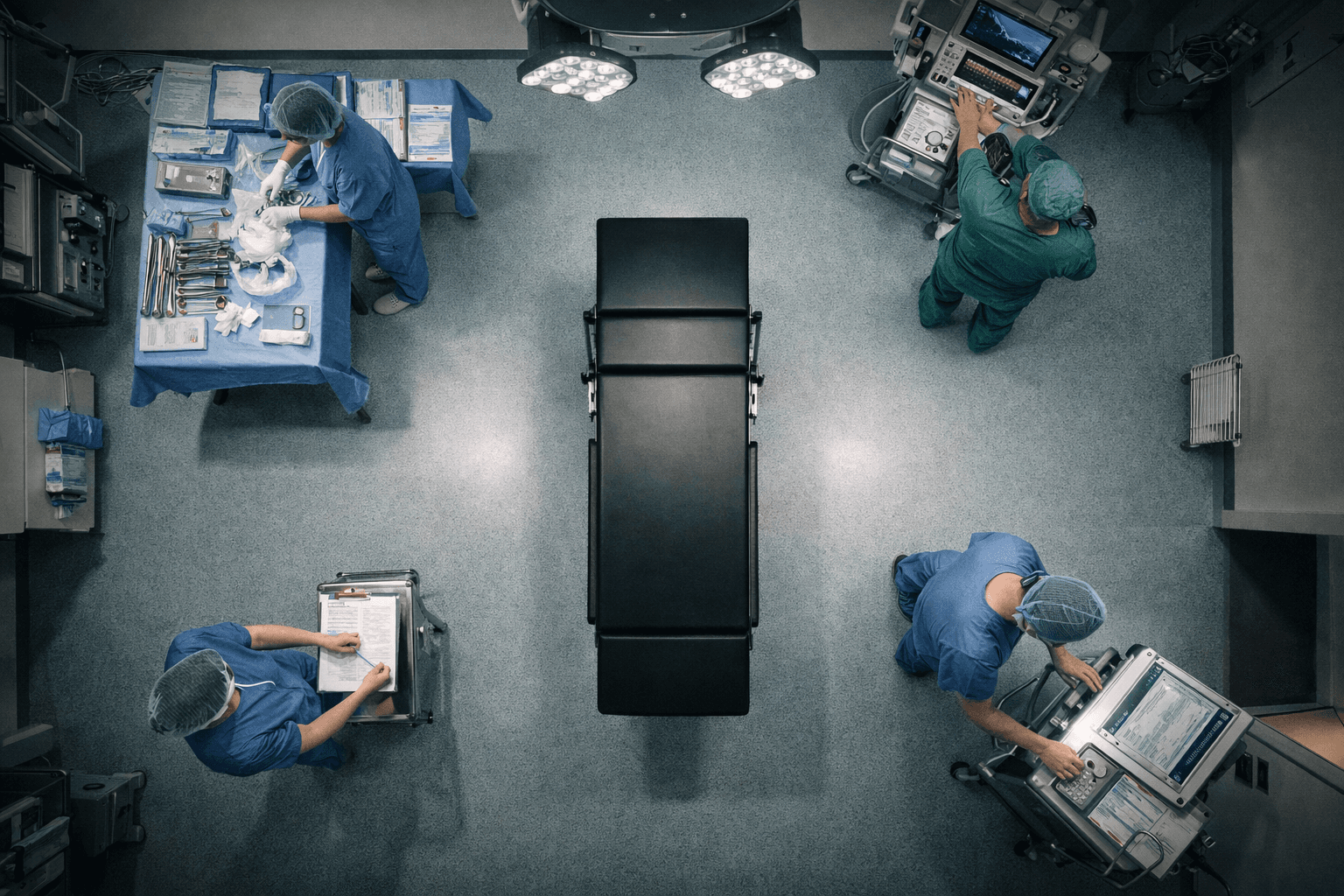
Where the operating room already is

GOOVIS, a head-mounted 3D display mounted on a Zumax-type surgical headband at the workbench.
One of the more interesting experiences has been exploring head-mounted displays in the context of existing surgical equipment.
Surgery isn't waiting for XR to arrive.
Surgeons have been using head-mounted visualisation systems for years. Devices like GOOVIS can bring high-resolution 3D views from microscopes and endoscopes directly in front of the user's eyes.
Wearing one mounted on a surgical headband at the workbench offers a different perspective on wearable technology.
Nobody in a clinical environment asks whether a device is immersive.
They ask whether the image is clear, whether the display stays aligned, whether it interferes with their existing equipment, and whether it remains comfortable throughout a long procedure.
These are fundamentally different design questions from those typically asked in consumer XR.
In the operating room, the device has to become part of the surgeon's workflow. It cannot demand constant attention or introduce unnecessary physical or cognitive burden.
This is an important distinction I keep coming back to: the best wearable technology isn't necessarily the one that offers the most features. It's the one that fits most naturally into the work.
The people and technologies that changed how I think
In 2024, I had the opportunity to visit Tobii's team in Mumbai.

That visit changed how I think about input.
Eye tracking isn't just another feature to add to a headset. It represents a fundamentally different way of interacting with computers.
Where you look carries information about attention, intent and context. Unlike touchscreens, keyboards or controllers, gaze is something we already use naturally to navigate the world.
Consider an operating room.
A surgeon's hands are occupied. Maintaining sterility is essential. Voice commands aren't always practical in a noisy environment. Yet the surgeon's eyes are constantly moving between the surgical field, instruments, monitors and surrounding team.
The eyes are already communicating information. The interesting engineering challenge is figuring out how to interpret that information without interrupting the work.
At Arab Health in Dubai the following year, the HTC headset was one stop among many. The ZEISS and Zumax booths, with their robotic and surgical microscopes, were others.

What struck me was the convergence.
Visualisation, imaging, data and the surgeon's line of sight were increasingly becoming interconnected.
It reinforced something I had started to suspect: the future of wearable computing won't be defined by displays alone. It will be shaped by how naturally we can combine what people see, what they do and what computers understand.
Standing on the shoulders of giants
None of this started with Apple, Meta or Microsoft.
In 1968, Ivan Sutherland created what is widely regarded as the first head-mounted display system. It was an extraordinary piece of engineering, even if the hardware was so cumbersome that it earned the name The Sword of Damocles.

Decades later, Google Glass attempted to bring computing into everyday eyewear. It was early, perhaps ahead of the social and technological infrastructure needed to make it mainstream, but the underlying idea wasn't wrong.

Then came successive generations of VR headsets, mixed-reality systems, spatial computing platforms and increasingly capable smart glasses.
Every new launch stands on decades of work in optics, displays, tracking, ergonomics and human-computer interaction.
I find this history important because hardware development has a way of making us believe we're solving entirely new problems.
Often, we're not.
We're revisiting old problems with better components, better processing power and a more mature understanding of human behaviour.
Builders who ignore that history tend to rediscover expensive lessons through their own prototypes.

Why all-day beats immersive
If there's one thing these four years have taught me, it's that the most important number on a wearable device's specification sheet might be its weight.
The Apple Vision Pro is an extraordinary piece of engineering. Its display quality and spatial audio are among the most impressive experiences I've encountered in a headset.
But at approximately 600–650 grams, depending on configuration, there's a physical trade-off. Wearing something that substantial for extended periods is a very different proposition from using it for a dedicated immersive experience.
Now consider the Meta Ray-Ban Display, at approximately 69 grams for the glasses.

The experiences are fundamentally different. One offers an immersive spatial computing environment; the other takes a much lighter approach to bringing digital information into everyday life.
But the contrast illustrates something important.
Immersion is valuable. Wearability is essential.
A device designed for an hour of entertainment can afford to make different compromises from one designed to accompany someone through an entire working day.
In a hospital, a factory, a laboratory or even an ordinary office, the requirements change.
Weight distribution matters. Heat matters. Battery life matters. Optical alignment matters. The ability to put the device on, get your work done and forget that you're wearing it matters.
The next generation of wearable computing will have to solve these problems, not simply deliver better displays.
I suspect some of the most successful devices won't look particularly futuristic at all.
They'll just work.
Building responsibly: The camera is never neutral
There's another dimension to wearable computing that becomes particularly important when cameras enter the picture.
A camera on someone's face is never neutral.
People around the wearer have legitimate questions:
Is this recording? Where does the footage go? Who can access it? How long is it stored? Can recording be stopped?
These questions become even more consequential in a hospital.
A wearable camera in an operating room doesn't just capture the person wearing it. It can capture patients, other healthcare professionals, conversations, medical records and highly sensitive clinical information.
This creates responsibilities that cannot be addressed through a privacy policy alone.
They have to be considered during product design.
Recording states should be unambiguous. Consent should be incorporated into clinical workflows. Access controls and data governance should be designed into the system. The people being recorded should understand what is happening and why.
Technology should not make people feel that they have lost control of their environment.
I believe this is particularly important as AI-enabled wearables become more common. The more capable our devices become at seeing, listening and interpreting the world, the more carefully we need to think about the boundaries of that capability.
Building responsibly isn't something to address after the product works. It is part of making the product work.
Where this is taking me

All these experiences have increasingly influenced what we're building at Nuevata.
We're exploring wearable capture and streaming for the operating room, designed around the realities of clinical workflows and the people who use it.
Our work with IRIS and the broader Nuevata platform comes from a simple observation: surgery is one of the most information-rich human activities, yet much of what happens during an operation remains undocumented in a structured, usable form.
We want to change that.
But building for the operating room requires a different mindset from building another consumer wearable.
The device has to work with existing surgical equipment. It has to respect the surgeon's movements and visual attention. It has to be comfortable enough for extended procedures, reliable enough for clinical environments and responsible in how it captures and handles information.
And beyond the hardware, there's an interesting opportunity to turn first-person surgical experiences into structured data that can support research, education and surgical intelligence.
The more I explore XR, the more I realise that the interesting question isn't simply how we put displays in front of people's eyes.
It's how we build systems that understand what people see, what they do and what they need, without getting in their way.
After four years of wearing, testing and building around these technologies, I've come to believe that the best wearable computer might be the one you eventually stop noticing.
Not because it does less, but because it understands the person wearing it, the environment they're working in and the task they're trying to accomplish.
That's the direction I'm interested in exploring.
And increasingly, that's what we're trying to build at Nuevata.

The future of spatial computing won't come from one company winning. It'll come from many builders learning in the open, sharing what works, questioning what doesn't and making technology more human along the way.
If you're working on wearables, XR, Physical AI or SurgTech, I'd love to compare notes.
Reach me at prashanth@nuevata.com.